Design & physical computing
Parents United
Exploring how single parents can coordinate help with the people they trust.
The design question
How might we make communication between single parents and their support system easier? Coordinating availability, locations, and requests for help could create lengthy back-and-forth conversations.
Research & my role
I worked with Grace Zhu, Katie Yang, and Aylee Neff. Each team member conducted an interview with a single parent and created storyboards. Together, we developed the research and design artifacts documented in the original case study.
Across four interviews, the team identified the importance of close friends and family, the difficulty of finding personal time, and the coordination involved in getting help. We synthesized findings through affinity mapping, personas, and a user journey map.
From findings to flows
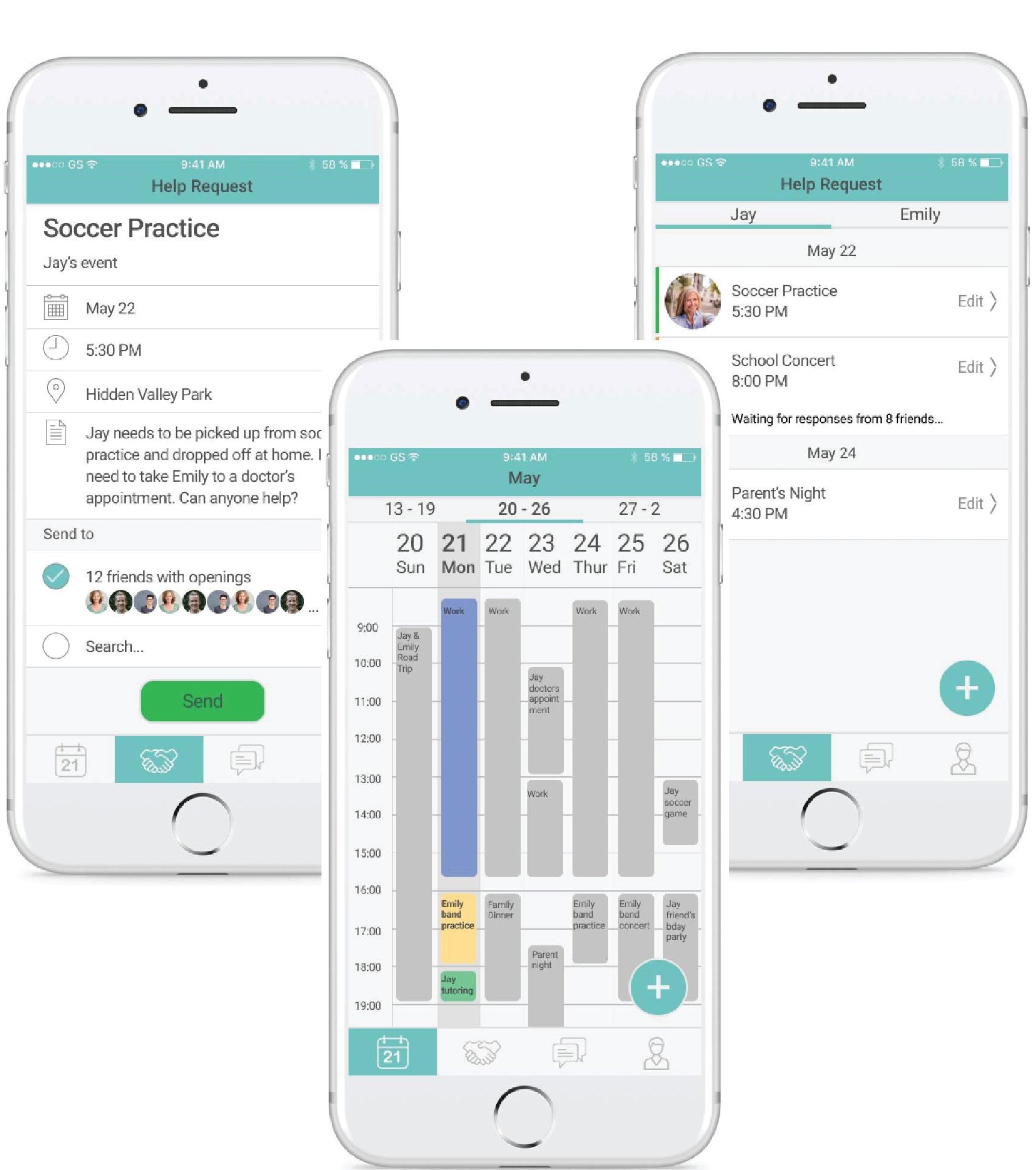
We focused the design on three tasks: adding an event to a calendar, requesting help, and accepting or declining a request as a support member.
We developed design requirements, storyboards, information architecture, paper prototypes, annotated wireframes, and high-fidelity mockups.
What changed through evaluation
Four paper-prototype usability studies helped us identify improvements:
- Use a consistent navigation bar so key features remain accessible.
- Add a clear way to return from secondary screens.
- Break longer tasks into smaller steps and simplify interface language.
- Use a weekly calendar view to reduce the information shown on the home screen.
The team also revised the journey map from a general day-in-the-life view to the specific experience of finding someone to pick up a child from practice.
What I would carry forward
The project is a design concept, rather than a released app. While our interviews included single parents, the paper-prototype studies did not test with that intended group. We also identified support members as a group that needed further research.
A next research round would include both groups and test how well the proposed coordination flows fit their real routines.